Beyond the Lecture Theatre: Students, Festivals and Practice
A short essay by Offline's Brian Carroll reflecting on the challenge of stressing the value of photography festivals and local events to students and graduates.
One of the recurring, hand-wringing contradictions in photography education today is that students often want professional insight, industry access and meaningful contact with working photographers, yet may not always attend the very events where these things are readily available.
As demonstrated by The EYE Festival last weekend, when a local photography festival brings internationally respected practitioners to Wales, students, as seems so often the case, can be thin on the ground. This raises an uncomfortable, but useful, question: what is the student’s responsibility to their own professional practice?
This is not a simple matter of blaming students. Attendance is never just about enthusiasm. Many students work part-time jobs, commute long distances, manage family responsibilities, struggle with confidence, or simply cannot afford tickets, travel, food and accommodation. Others, perhaps many, may not yet understand the value of such events because they are still thinking of photography education as something that happens mainly in the studio, seminar room or module brief. A student who does not attend a festival is not necessarily lazy or indifferent. They may be behind with studies, under-informed, anxious, or unsure whether such events are really “for them”.
Professional Practice
Whatever the reason, the dilemma remains. Photography is not only a subject studied in education; it is a field of professional practice within the UK’s creative industries, media sector and public culture. The professional life of a photographer is shaped as much by listening, meeting, observing and participating as it is by making images. That penny often drops very quickly when graduates realise that local festivals, talks, exhibitions, workshops, portfolio reviews and informal gatherings are not extras floating at the edge of the curriculum. They are part of the wider ecology in which a new photographic identity, practice, or even “brand” is formed.
For students, this matters because professional practice begins before graduation. It begins when a student first asks a question after a talk, introduces themselves to a photographer whose work they admire, attends a portfolio review, volunteers at a festival, writes a reflection on an exhibition, or simply sits in a room and hears first-hand how a photographer has sustained a career over decades. These moments may not produce immediate results, nor lead directly to a job, commission or publication. But over time they accumulate, each an experiential dot connecting with another, until eventually — boom — students begin to understand how the world of photography actually works.
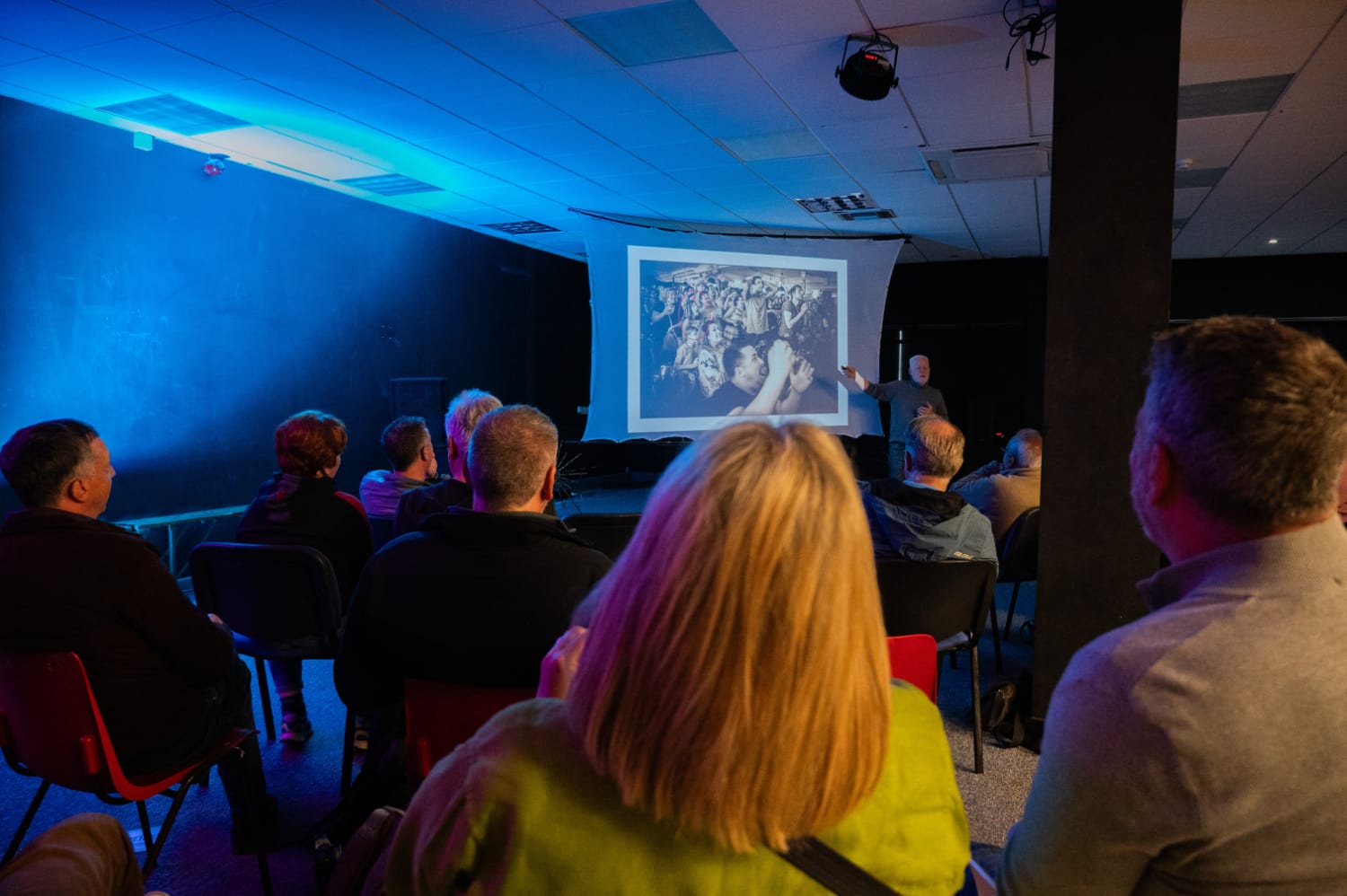
A photography festival talk offers a kind of learning that is difficult to reproduce in formal teaching. In the classroom, students often see finished projects: the exhibition, the book, the website, the award-winning image. In a live talk, as was the case at The EYE 2026 event, attendees heard about the uncertainty behind the work: the failed attempts, financial pressures, ethical dilemmas, negotiations with subjects, editing decisions, rejections and, sometimes, plain old prejudice. That kind of honesty is invaluable. It helps demystify professional success and shows students that careers are very rarely linear, and that serious photographic work often grows slowly through persistence, relationships, luck and reflection.
Proximity
There is also a question of proximity. Students in Wales and south west England do not need to wait for permission to enter the photographic world, nor do they need to imagine that meaningful photography culture exists only in London, Paris, New York or Arles. When an event such as The EYE International Photography Festival takes place in Newport, it brings professional practice into reach. It says, in effect, that serious photographic conversation around career progression and success — including routes beyond dependency on public arts funding — can happen here. For students in Wales, that matters. To ignore these industry-focused events can, perhaps unintentionally, reinforce the idea that culture is always elsewhere.
Educator role
Educators, of course, have a role here. They cannot and should not force attendance. But they can frame participation as part of becoming a photographer. They can discuss festival programmes in advance, connect speakers to modules, organise group visits, invite students to prepare questions, and build reflective tasks and group projects around attendance. They can also help students understand etiquette: how to introduce themselves, how to approach speakers respectfully, how to follow up, and how to make the most of a portfolio review without expecting instant validation. Professional Practice modules in higher education often talk a great game, but from my own observations and interactions with graduates, they regularly — sometimes woefully — miss the “stuff” that really matters.
There is value in educators attending these events themselves. If students are being encouraged to see festivals as part of their professional practice, the same principle applies to those who teach them. Photography educators need contact with the changing field: with new work, new debates, new routes into publication, new commissioning realities and new ethical questions. Their presence at festivals is not simply supervisory, it is surely part of their own continuing professional engagement with the creative industry sector.
When tutors attend talks, exhibitions and portfolio events, they return to teaching with fresher references, wider networks and a stronger sense of how the industry is shifting. They may meet photographers, curators, editors, publishers and festival organisers who could become visiting speakers, placement contacts, external mentors or collaborators. Just as importantly, they model the behaviour they are asking of students: curiosity, participation and a willingness to remain in conversation with the professional field. A photography festival is not only a student opportunity; it is part of the professional culture that keeps photography education alive and outward-looking.
Student & Graduate role
Recent graduates face a related but slightly different dilemma. Once outside education, support structures fall away. There are no tutors reminding them — if indeed they were told in the first place — about events, no module handbooks, no subsidised trips, no built-in peer group. This is precisely when local photography festivals become even more important. They offer a way to remain connected to a community of practice after the degree show has been taken down. For graduates trying to sustain momentum, events such as The EYE can provide encouragement, contacts, perspective and a reminder that professional photography is not a solitary pursuit, even when much work is made alone.
The challenge, then, is to shift how students and emerging photographers think about attendance. Photography festivals in Wales — The EYE, The Northern EYE, Ffoto Cymru and others — are not merely something to consume. They are places, spaces and experiences in which to practise being part of the field, whether that field is documentary, photojournalism, fashion, art photography or film stills. Listening is professional practice, as is asking questions and looking carefully at other people’s work. Learning how photographers speak about ethics, money, failure, collaboration and ambition is professional practice. So is being present.
The Festival role
There is also, perhaps unsurprisingly, a big responsibility on festivals. If organisers want students to attend, they need to make the invitation visible, affordable and welcoming. Student tickets, volunteering opportunities, clear communication with schools, colleges and universities, and early outreach to course leaders can all help. The message should not simply be “come because this is good for you”, but “you belong in this conversation”. For students who may feel intimidated by world-class speakers or established professional networks, that distinction matters.
Ultimately, the student dilemma is not about one missed event or one underrepresented audience. It is about how emerging photographers learn to take themselves seriously. No one can build a practice for them. Tutors can encourage, festivals can open doors, institutions can support, but students and graduates must also choose to step out of the shadows and onto the playing field.
Smaller local photography events such as exhibition openings, Offline Journal’s SIGNATURES events on photobooks and self-publishing, or organised photowalks are often easy to engage with and completely free. Festivals move things up a notch and require funding to cover venue hire, exhibitions, guest speakers and other expenses. Whatever the flavour of photography event, none is peripheral to professional development.
Outside the classroom and lecture theatre, these events are where the edges between education, industry, community and culture become visible. To support and attend them is not simply to be inspired for a day, a weekend or a month. You are recognising that becoming a photographer involves participation: showing up, listening, thinking, speaking, connecting and, hopefully, coming back for more.
By the time the next festival arrives, the most valuable question for students may not be “Is this required?” but “What might I miss if I’m not there?"
Brian Carroll, May 2026
Feel free to comment below on this topic with any observations, views or personal experiences on attendance make-up at photography festivals and events.
Essay © 2026 Brian Carroll for Offline Journal. Photograph © Glenn Edwards
Member discussion